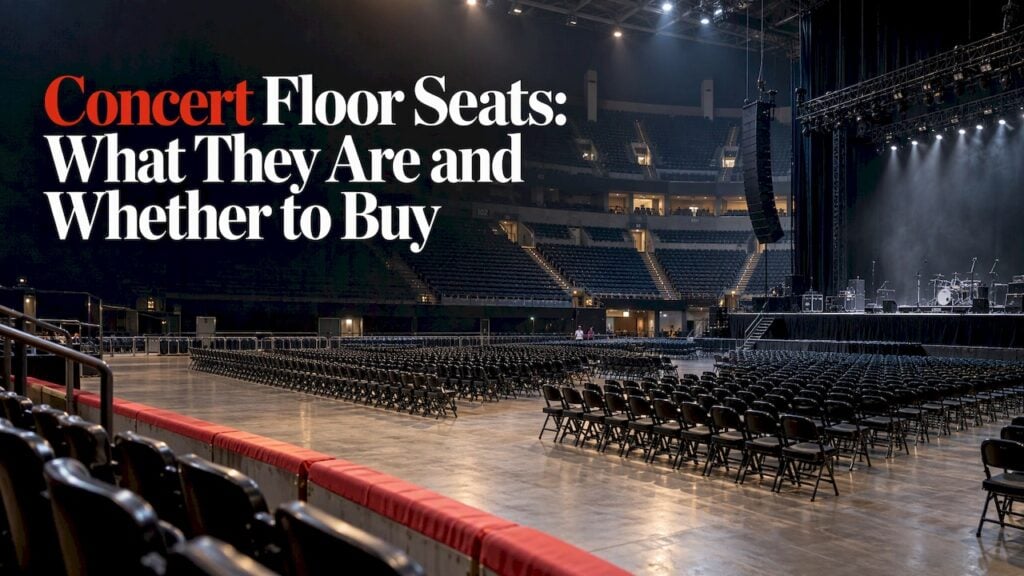
Concert floor seats are the tickets on the flat, ground-level area of an arena or stadium, directly in front of or around the stage. They are usually the closest and the priciest in the building, but “floor” can mean two very different things: assigned chairs in rows, or an open standing area with no seats at all. Whether floor is worth it depends on which version you are buying, where in the floor you sit, and what you want from the night.
TL;DR
- Floor seats sit on the main floor near the stage. Check whether your ticket is a reserved seat or standing room (general admission) before you pay.
- The floor is flat, so your view depends on row, section and the people in front of you. Raised lower-level seats often give a cleaner sightline from farther away.
- Layouts change with every tour. Always check the seating chart for the specific show, not the venue’s default map.
- Most good seats go in presales. Line up card, newsletter and artist sign-ups, and save payment details and ID before the queue opens.
- Presales give early access, not a guarantee. Have a backup plan.
What counts as a floor seat at a concert
At a concert, floor seating is the area of the venue that, on game nights, would be the court or ice. Floor seats are set up on that main floor, the flat, ground-level area in front of or around the stage, and they tend to be the most desirable and expensive seats in the building.
The label hides a split that trips up first-time buyers:
| Type | What you get | What to expect |
|---|---|---|
| Reserved floor seats | A chair in a numbered row and seat | Your own spot, a place to sit when the crowd stands, and a fixed distance from the stage |
| Standing floor / general admission (GA) | A ticket to the floor area with no assigned seat | Standing for the whole show, with your position set by when you arrive and how you hold your ground |
Standing room only is the part of the floor where there are no seats and guests must stand for the entire length of the show. Some tours sell only reserved floor, some sell only GA floor, and some split the floor into a seated rear and a standing pit near the stage. The ticket listing usually says so, so read the description before you click buy.
If the listing just says “Floor” and the artist is known for a standing crowd, treat it as a question to answer, not an assumption. Read the event page notes, and look at the venue map for that show.
How floor sections are laid out
For a traditional end-stage setup, the stage sits at one end of the arena and the floor fills the space in front of it. Floor sections are typically numbered or lettered, and the ones nearest the stage are the premium blocks. A common pattern is a block of sections up front, a middle group, and a rear group near the soundboard and the start of the raised seating. Exact names and numbers differ by building, so use the venue’s own chart for your show.
The layout changes for several reasons:
- Stage position. End stage, center stage, “in the round” and thrust stages with a runway all change which floor seats are close and which face the side of the stage.
- Stage size and production. Large video walls, sound towers and B-stages take up floor space. Seats that were front row at one show may be well back, or removed, at another.
- Seated or standing. The same floor may be filled with chairs for one tour and cleared for GA on the next.
- Capacity decisions. Promoters may close off back sections or curtain off the upper level for smaller shows.
That last point matters when you compare past shows with a new one. A friend’s photo from last year’s concert in the same arena tells you about their night, not yours.
Read the map for your show
On the ticket page, look for the map labeled for the event, not a generic venue chart. Check three things: where the stage is drawn, whether the floor shows individual seats or one open block, and where the first row of the raised sections begins. If a floor block looks sideways to the stage, the angle will be steep even if the seat is technically close.
What affects your view from the floor
The floor of an arena is flat. Unlike the stands, nothing lifts you above the people in front. That one fact explains most of the arguments about whether floor is worth it.
Row and section. The first rows in the center block are the best floor seats for most fans: close, central, and with a clear line to the performers. Farther back on the floor you are still low, with a more distant and flatter view.
Height of the people in front. In reserved seating, a tall person in front, or a standing crowd, can block your line. Many fans stand for most of a show, which means a seated floor often becomes a de facto standing floor. If you are shorter, think about this honestly when comparing a back-floor seat with a raised seat.

Stage height and design. A high stage helps the floor see performers; a low stage with screens on the sides means fans farther back watch the screens more than the artist. Check photos of the tour’s stage if they exist.
Angle. Seats on the far side of the floor look at the stage from an angle, and some side stage elements may be hidden. Center beats side for sound, too, because most speaker arrays are aimed at the middle.
Sound. Close to the stage you hear the stage monitors and the front speakers; mid-floor near the soundboard is where the mix is usually tuned. This is a general live-sound habit rather than a rule, so treat it as a tiebreaker.
How to check a specific seat
- Open the seating chart for your date and click the section to see the row range.
- Look for a “view from seat” photo for that block. Fan-submitted photos exist for many venues, and they usually show a hockey or basketball layout, so mentally adjust for the concert stage.
- Compare the seat to the stage position on the chart. Center is worth more than a few rows closer on the side.
- Note the row number. Counting rows from the stage tells you more than the section label.
- Remember the layout may shift. If the seat map for your show is labeled “limited view” or “obstructed,” read the note.
Our guide to choosing where to sit at concerts walks through this process for different venue types.
Floor seats vs. lower-level seats
This is the question behind most searches for floor seats: is the premium worth it, or are raised seats better? The honest answer is that it depends on the venue and your priorities.
| What you care about | Floor | Lower-level (raised) |
|---|---|---|
| Being close to the artist | Strongest in front rows | Moderate, but still clear in the first rows |
| Seeing over the crowd | Depends on the row and the people ahead | Elevation helps, especially in the middle rows |
| Atmosphere and energy | Immersive, in the middle of the crowd | A bit removed, with a full-room view |
| Comfort | Chairs on flat ground, or standing the whole time on GA | Tiered seats with more room to sit when you want |
| Seeing the whole production | Limited in the back | Often better, including lighting and stage design |
| Price | Usually the highest | Usually lower |
Floor tends to win for fans who want to be inside the show: close to the stage, surrounded by other fans, and at home singing along. Raised lower-level seats, especially centered ones, tend to win for fans who want an unobstructed sightline, a place to rest, and a view of the whole production.
Two practical rules help:
- A front-center lower-level seat can beat a back-floor seat for both view and comfort, often at a lower price.
- If you are choosing between side floor and center lower level, the lower-level center usually gives a better angle.
Advantages and trade-offs of floor seats, honestly weighed
Floor seats offer real strengths. You are near the stage, you feel the volume, you see the performers’ expressions, and the crowd energy around you is part of the show. For artists who engage the front rows, such as handing out items or touching hands near the barrier, nothing else comes close.
Choosing well also means planning for how the floor behaves:
- Standing. If the crowd stands, you probably will too. Wear comfortable shoes and plan on a few hours on your feet.
- Bags and gear. Check the venue’s bag policy before you go, so you are not stuck at the door.
- Exits and restrooms. The floor can be slow to leave. Plan your meeting spot.
- Timing. GA floor positions reward early arrival. Check the doors time for your show.
Choose floor when closeness and atmosphere matter most. Choose a raised seat when you want a clear, comfortable view of the entire stage.
How people get front-row seats
Front-row seats go first, and they go to the people who are ready first. There is no secret trick; there is preparation.
Get into presales. Presales are where most good seats go. Prices are usually the same as the general sale, but access opens earlier and seat selection is better. Check each show’s presale requirements, which can include card presales, venue or promoter newsletters, and artist registration.
Stack the access routes. Credit card presales from Amex, Citi, Chase and Capital One often open before artist or fan club presales, and streaming services may flag listeners who follow an artist and send them a code for certain shows. Holding more than one route gives you more than one shot.
Prepare before the queue opens. Save your payment details and a verified photo ID in your account first, so checkout takes seconds, not minutes.
Be flexible. The very first rows may be held back for fan clubs, packages or the artist’s team. Aim for the first few rows of a center block rather than only row one.
Know the platform’s queue. Our waiting room guide explains how queues work and how to prepare for them.
For GA floor, the “front row” is a place, not a seat. It goes to those who line up early, so check the venue’s rules on lines and wristbands.

Preparing for the on-sale
Use this checklist in the week before tickets go live:
- Find the dates. Note the presale and general sale times in your time zone.
- Sign up for artist and venue lists. Our guide to artist presale sign-ups covers how registration works and what to expect.
- Check your cards. If you hold an eligible card, review the card presale basics and see what the issuer offers.
- Look at the seat map in advance. Decide your target floor sections and a fallback lower-level block.
- Set a budget. Floor prices can jump with dynamic pricing, so decide your ceiling now.
- Log in early. Test your account, payment method and ID 15 minutes before the sale.
- Use one device and one browser tab per account. Avoid refreshing in a panic.
When a venue uses a different ticketing system, the steps are similar. The presale code guide for another major platform shows where such codes usually come from.
Presales provide early access, but they do not guarantee tickets for everyone. Demand can exceed supply even in the first minutes, so decide your plan B before the sale starts. If the show sells out, read our guide to finding sold-out concert tickets safely.
Our perspective
Most fans we hear from do not lose floor seats because they lack a magic code. They lose them because they did not know how presales work, did not know what “floor” meant on that tour, or logged in too late.
That is why we focus on preparation you can control: free memberships, artist sign-ups, card and venue perks, and a clear plan for the seat map. Codes can help, but they are not the foundation, and no code makes every show available to everyone.
Our advice on floor seats is simple. Decide first whether you want to be close or want to see everything. Read the map for your show. Then set up every legitimate route to early access, so that when the queue opens, you are ready. We are independent of ticket sellers, and our guides are written to answer the questions real fans ask.
Find your show and get ready
If you already know which tour you want, our site tracks tour dates, on-sale timing, presale routes and venue-specific buying guides in one place, so you can plan your floor-seat strategy without hunting across a dozen pages. Start at the Ticket News Hub homepage and look for your artist or venue.

We also publish artist-specific pages with seating charts and floor, lower-level, club and general admission options, such as our guide for Brandi Carlile tour dates and seating.
FAQ
Are concert floor seats worth it?
They are worth it if you want to be close to the stage and in the middle of the crowd, and if the floor is reserved or you are comfortable standing. If you want a clear, comfortable view of the whole production, a centered lower-level seat may suit you better. Check the seat map for your show before deciding.
What is the difference between floor seats and general admission?
Floor seats are assigned chairs with a row and seat number. General admission floor is standing room with no assigned spot, where your position depends on when you arrive. The ticket listing for the show should say which one you are buying.
How do people get front-row seats at concerts?
Mostly through preparation: joining presales through artist sign-ups, newsletters or eligible cards, saving payment details and ID in advance, and logging in early. Presales often have better seat selection than the general sale, but they do not guarantee front row.
Are higher seats better than floor seats?
Sometimes. Raised seats let you see over the crowd and take in the whole stage, while floor seats put you closer to the artist. Because the floor is flat, a back-floor seat can have a worse view than a center lower-level seat.
Can the floor layout change from show to show?
Yes. Stage position, production size and whether the floor is seated or standing all vary by tour and sometimes by date. Always use the seating chart shown for the specific event you are buying.
Sources
- How to Find the Best Way to Get Concert Tickets in 2026
- Concert Seating Types (PDF)
- What Are Floor Seats? A Guide to Floor Seating