Ticketmaster fees are the charges added on top of a ticket’s face value: a per-ticket service fee, a venue-set facility charge, sometimes delivery, and taxes. How much they add depends on the event, the venue and the seller. You usually can’t remove them, but you can see them early, compare totals and cut the optional ones.
TL;DR
- Face value is set by the event organizer. Fees on top come from Ticketmaster (service fee) and the venue (facility charge), plus delivery and taxes where they apply.
- Since the FTC’s fee rule took effect in 2025, live-event sellers must show a total price upfront that includes mandatory fees, though taxes can come later.
- Fees vary widely. Allegations in a 2025 lawsuit put mandatory fees at 24% to 44% of the total ticket price, while Ticketmaster UK reported a 10.5% average in 2024.
- The fee dropdown at checkout shows the breakdown. Mobile delivery, and sometimes box-office purchase, keep optional charges down.
- Presale access and a clear plan help you spend less time hunting for tickets and fewer dollars on resale markups.
Table of Contents
- What fees can appear on a Ticketmaster order
- How much do the fees add up to?
- Who gets the money
- What the FTC rule changed in 2025
- How to see the full breakdown before you pay
- How to avoid or reduce concert ticket fees
- Why a clearer total still needs a closer look
- Our perspective
- Where to start planning your next purchase
- FAQ
- Sources
What fees can appear on a Ticketmaster order
Ticketmaster says the price you pay can include per-ticket service fees, venue-set facility charges, delivery fees and applicable taxes. Resale tickets are priced by the reseller and can carry resale service fees too.
Here is what each line means in plain terms.
| Charge | What it is | Who sets it |
|---|---|---|
| Face value | The base ticket price | Event organizer (artist team, promoter) |
| Service fee | Per-ticket fee for the sale | Negotiated and shared among event participants |
| Facility charge | Fee tied to the building | The venue |
| Delivery fee | Cost of how tickets reach you, where applicable | Depends on the option you choose |
| Taxes | Local taxes | Government |
The exact mix changes by show. A stadium date and a small club date can look very different, even on the same day.
Face value is not Ticketmaster’s number
Ticketmaster’s help center explains that the event organizer decides the face value, weighing things like production costs and venue size. That is why two tours of similar size can open at very different prices before a single fee is added.
Facility charges stay with the venue
Per Ticketmaster, facility charges are set by venues, vary by venue and event, and are kept by the venue rather than by Ticketmaster. Venues use them for things such as staffing, insurance and suppliers. If your total looks high at one arena and lower at another for the same artist, this line is often part of the reason.
How much do the fees add up to?
There is no single honest percentage, because the answer depends on the show. Two data points show how wide the range is.
- Allegations in the U.S.: The Utah Attorney General said a 2025 lawsuit by Utah and the FTC alleged that mandatory fees averaged 24% to 44% of the total ticket price, and that consumers paid $16.4 billion in mandatory fees from 2019 through 2024. These are allegations, not court findings.
- Ticketmaster’s own UK figure: In a submission to a UK parliamentary committee, Ticketmaster UK reported a 2024 average booking fee of 10.5% of face value, with a highest contractual fee of 15% and a £2 minimum. That is a UK average, not a U.S. one.
The gap between those numbers comes down to definitions: what counts as a fee, what the percentage is measured against, and which events are in the sample. For your own purchase, the only number that matters is the one on your checkout screen.
A worked example
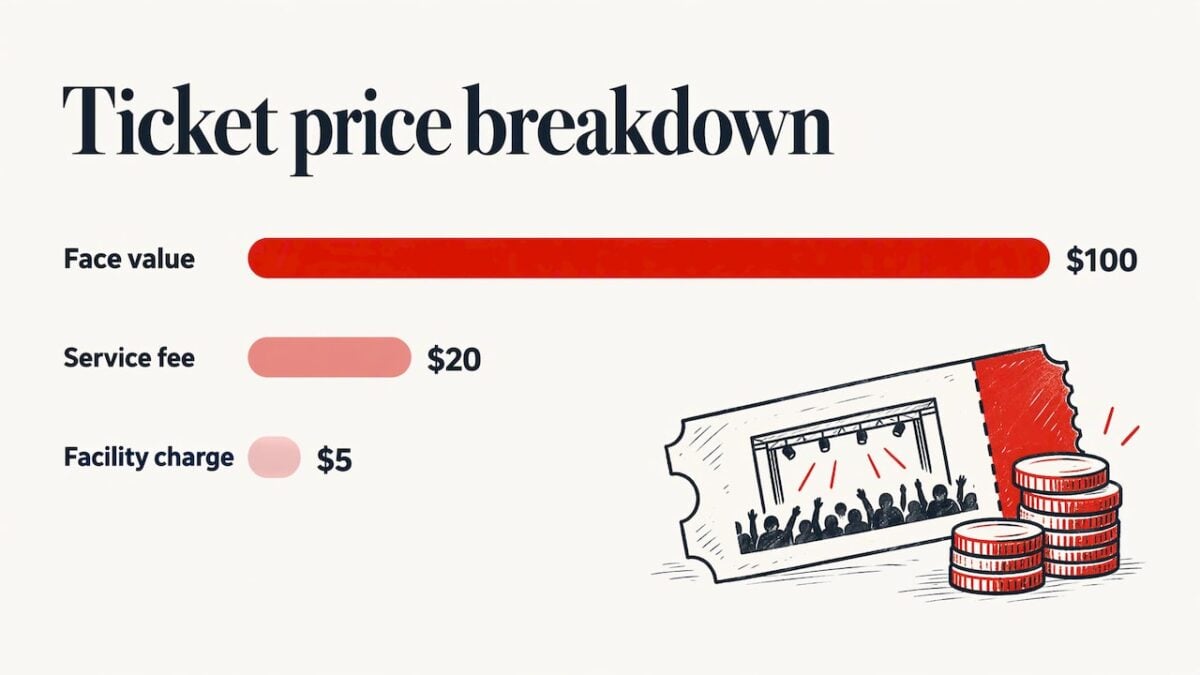
Suppose a ticket has a $100 face value. If a service fee of $20 and a facility charge of $5 apply, you would pay $125 before taxes and any delivery charge. The fees would be about 20% of the total. At another venue, the same $100 ticket might carry a smaller facility charge and a different service fee. The structure is the same each time. Only the amounts move.
Who gets the money
Ticketmaster says service fees are generally negotiated and shared among event participants. Its portion goes toward technology, customer support, secure ticketing tools and typically card-processing costs. In May 2026, Marketplace reported that a Ticketmaster spokesperson put the company’s share at roughly 5 to 7% of the total ticket price, with venues receiving the facility fees.
The UK submission makes a related point: artists and their teams determine prices, how many tickets are sold and when, while Ticketmaster supplies pricing tools. In short, a fee you pay at checkout may be split across several parties. That is useful when you wonder why a fee stays high even when you buy through a different channel.
What the FTC rule changed in 2025
The FTC’s fee rule is the biggest shift for U.S. buyers. According to the agency’s guidance on the rule, covered live-event sellers must disclose the total price upfront, including mandatory or unavoidable fees they know and can calculate. They may leave out taxes, government charges, shipping and optional extras at first, as long as those are disclosed before payment.
The same guidance says:
- The upfront total must be more prominent than other pricing information.
- Any excluded charges must be disclosed with their nature, purpose and amount before you pay.
- Sellers must not misrepresent what a fee means.
- The rule does not ban dynamic pricing, provided the disclosures are not misleading.
PBS reported that on May 12, 2025, Ticketmaster said it would begin showing the full ticket price as soon as consumers start shopping. Ticketmaster also publishes an All In Price page that defines the All In Price as the ticket price plus fees, with local taxes and delivery fees, when applicable, added at checkout.
Fees can be reshuffled, not just removed
Showing fees upfront is not the same as lowering them. In April 2026, reporting based on documents from public venues described a case where a venue dropped a $6 order processing fee and the per-ticket service charge rose by $2. Live Nation disputed the FTC’s allegations in its lawsuit. The practical lesson for you is to compare the all-in total across dates and venues, not a single line item.
How to see the full breakdown before you pay
Ticketmaster’s help center says you can open the dropdown arrow next to the subtotal to see the service fee, and that the full breakdown is shown at checkout. After you buy, your Order Details page keeps the breakdown. The UK, Canada and Ireland help pages describe the same dropdown and the same Order Details route.
A simple routine that takes two minutes:
- Pick your section and quantity, and note the upfront total.
- Open the dropdown beside the subtotal and read each line.
- Look at the delivery options. The default is not always the cheapest.
- Compare the same seat type on a second date or a nearby venue if you are flexible.
- Only then confirm payment.
Taking a screenshot of the breakdown helps if you need to compare later or question a charge.
How to avoid or reduce concert ticket fees
Be realistic here. The service fee on an online sale is part of the price of buying through that channel. What you can do is trim the extras and pick the route that costs least.
Choose the cheapest delivery option
Ticketmaster’s Canadian help page says mobile delivery is free for most events. Check which delivery options your event lists and choose mobile when it is available. Delivery fees depend on the option you select, so a paper or shipped option is where optional charges tend to appear.
Look at in-person purchase
Ticketmaster’s Canadian page says order-processing fees do not apply to in-person box-office purchases, and its UAE policy says retail outlet and box-office purchases usually avoid that fee. Those are country-specific policies, so check your venue’s box-office page for U.S. rules. Many buyers can’t visit a box office, and high-demand shows sell out online first, so treat this as an option for local shows you can plan around.
Buy at face value, not on resale
Resale tickets are priced by resellers and may carry resale service fees on top. If you can reach the primary sale, whether through a presale or the general onsale, the face value is set by the organizer instead of a seller reacting to demand. Resale prices can be many times higher for in-demand shows.
Count tickets before you start
Per-ticket fees multiply with quantity. Decide who is really coming before you get into the queue, then buy exactly that number. Last-minute changes in the waiting room are how people end up with extra tickets and extra fees.
Prepare so you are not forced into resale
The costliest outcome is missing the primary sale and paying resale prices. Our guide to the Ticketmaster waiting room walks through how the queue works and how to be ready. Our guides to Amex presale tickets and AXS presale codes cover the card-based and code-based routes.
Why a clearer total still needs a closer look
Seeing fees upfront solves one problem, but price tiers are another. In September 2025 the UK’s CMA said Ticketmaster had not adequately told Oasis queueing fans that standing tickets were offered at two prices, and that some platinum tickets cost almost 2.5 times the standard price without additional benefits. The CMA’s undertakings require Ticketmaster to warn fans 24 hours before tiered pricing, show available price ranges when queues begin, update fans when cheaper tiers sell out, avoid misleading labels and report compliance for two years.
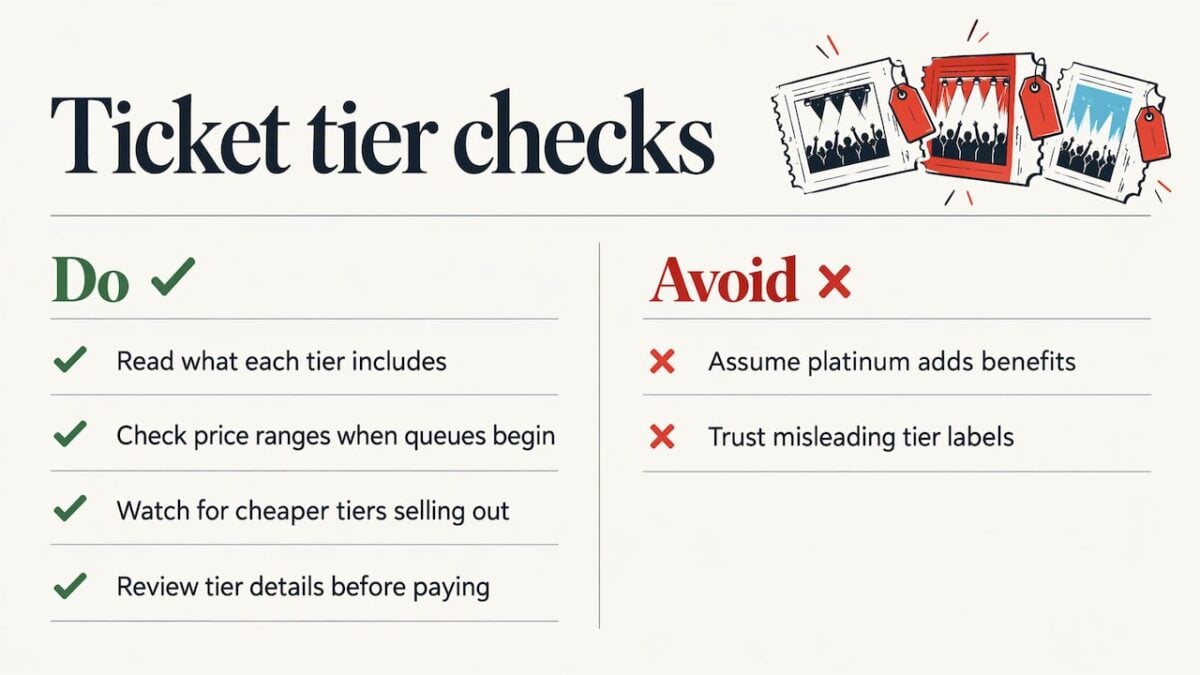
Those are UK commitments, but the habit travels well: read what each tier includes before you pay. It is the same skill needed anywhere access levels differ, and a guide to ticket types and access tiers shows how much the details of a ticket category can change what you get for the money.
Our perspective
Fees are the part of buying tickets that fans feel most and understand least. We think that is fixable, and it starts before the onsale, not at checkout.
At Ticket News Hub we are independent of ticket vendors, and our advice is built on that. We don’t promise a code that wipes out fees, because that isn’t how presales work. We focus on what is actually in your control: knowing which presale you qualify for, signing up for artist presales, using free memberships and card or venue perks, and arriving at the onsale with your plan ready.
Presales give early access, but they don’t guarantee tickets for everyone. That honesty matters. A fan who has a plan, knows the breakdown and has set a budget makes calmer decisions in the queue, and calmer decisions mean fewer expensive surprises.
Our guides aim to give you steps you can follow, not hype.
Capital
Where to start planning your next purchase
If you have a show in mind, start with the presale options for it, then work out your total budget with fees included. We cover presale methods, tour and onsale dates, promo code updates and venue-specific buying guides in one place.

Browse the Ticket News Hub home page to find the show you are after, and check the artist or venue guide before the onsale begins.
FAQ
How much are Ticketmaster fees on average?
There is no single U.S. average that everyone agrees on. A 2025 lawsuit alleged mandatory fees averaged 24% to 44% of the total ticket price, while Ticketmaster UK reported a 10.5% average of face value for 2024. Your checkout breakdown is the only figure that applies to your order.
Why are Ticketmaster fees so high?
Ticketmaster says service fees are negotiated and shared among event participants, and facility charges go to the venue. A fee on your total can therefore reflect several parties. Ticketmaster’s spokesperson put its own share at about 5 to 7% of the total ticket price.
How do I see the fees before I buy?
Open the dropdown arrow next to the subtotal during checkout to see the service fee and the full breakdown. After purchase, Order Details keeps it. U.S. sellers of live events must also show a total price upfront that includes mandatory fees.
Can I avoid Ticketmaster service fees?
Not on most online sales, because the service fee is part of the price of the sale. You can reduce optional charges by choosing mobile delivery where it is offered, buying only the tickets you need and checking whether your venue’s box office has its own policy.
Sources
- How are ticket prices and fees determined? (Ticketmaster, U.S.)
- How do I find ticket prices and fees? (Ticketmaster, U.S.)
- How do I find ticket prices and fees? (Ticketmaster, UK)
- How are ticket prices and fees determined? (Ticketmaster, Canada)
- We’re All In at Ticketmaster
- Utah and the FTC sue Live Nation and Ticketmaster
- Business and Trade Committee submission, Ticketmaster UK
- Why does Ticketmaster charge such high fees? (Marketplace)
- The Rule on Unfair or Deceptive Fees: FAQ (FTC)
- A Biden-era junk fee rule is now in effect (PBS NewsHour)
- Ticketmaster secretly raised fees at 26 venues after FTC (Rolling Out)
- CMA secures changes from Ticketmaster following Oasis tickets investigation
- Ticket types guide